
There are two reasons why I finally decided to start digging deeper into my family history a couple of years ago, and the stories of those that came before me. Firstly because tracing her family ancestry is something that Sonia’s been actively doing for many years and I wanted to find something we could both work on together. And secondly, because I think it’s important we have a true understanding of our own family history and exactly where we come from. Our roots if you like.
I find it fascinating when we happen to stumble upon a family member with real character, someone who passed a long time ago, yet still has a story to tell even today. Wartime soldiers, petty criminals, victims of murder, the hard working men and women that helped to not only shape our past, but also made it possible for us to be able to shape our future.
I also find it somewhat satisfying when we manage to uncover that one piece of evidence, that one document, that one snippet of information which allows us to add A to B and finally come up with C when we’re researching an individual, who up until that point, had been illusive and had often left us scratching our heads. But then all of a sudden, you’re able to join up the dots and start to make more sense of things.
There’s never a truer word spoken than when Sonia says that ‘researching you family tree is just like doing a jigsaw puzzle, but with an unknown number of pieces and no picture on the lid to follow’, because that’s exactly what it is.
Now you’d be excused for thinking that the title of this post, especially the Riches to Rags part, may relate to a certain family member, or branch of my lineage that somehow managed to find great wealth before managing to suddenly lose it all again, but you’d be mistaken.
It actually relates to a major fu-bar we made whilst researching my maternal family lineage earlier this year. A schoolboy error if you like. A lack in judgement on our part. Whatever you want to call it.
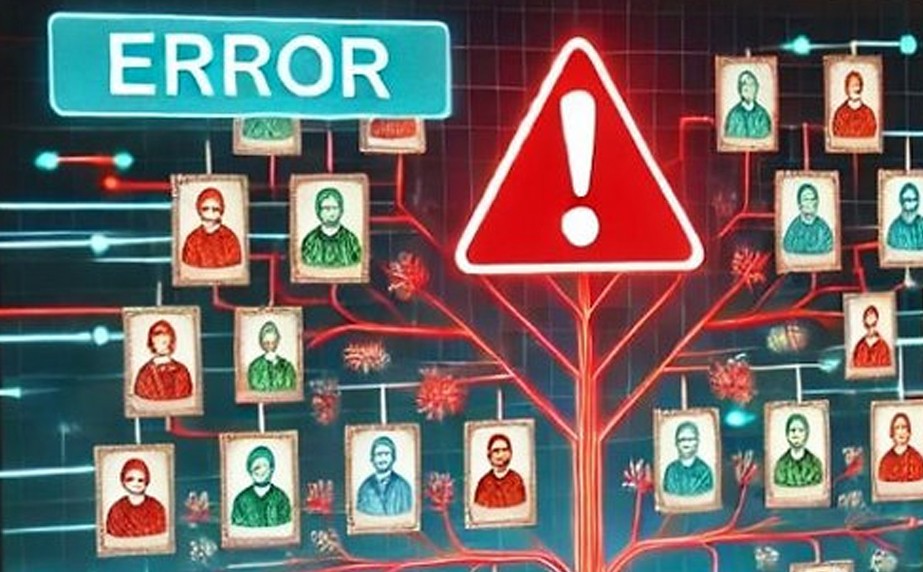
At the end of the day we failed to research my 11th times Great-Grandfather on my mothers side correctly, and as a result, we ended up following completely the wrong path for months on end. All because of one incorrect entry in the family tree. A ghost entry. An entry without any evidence what so ever to prove that that individual was ever related to my lineage at all. A random entry with the same surname which someone somewhere along the line, another distant relative perhaps, mistakenly added to their tree because it sounded plausible, but without having any actual documented proof, and many others, us included, instinctively just decided to believe them and follow their decision without researching things properly.
But as much as we’re here to learn from our mistakes, and learn we most certainly have, it’s also important to remember that whenever you’re trying to track down your ancestors from poorly documented sources, wrongly or none-transcribed church registers which are sometimes illegible and include entries made in Latin, and the simple trust in others, mistakes are also easily made if you’re not careful. And sometimes, when so many others before you have accepted things as fact, and it’s proving difficult or near impossible to come up with an alternative answer. It’s oh so simple to stray and get yourself lost along the way.
And that’s exactly what we did. That one wrong entry on my family tree has led to generations of people being added, both before and after, who simply shouldn’t be there.
We literally went from having a whole array of newly found ancestors to investigate one night with ties to great wealth, land, stately homes, castles, and links to both motor car and locomotive manufacturing. There were Sir’s, Lady’s, Mayor’s, politicians, Marshal’s of the Irish army, and Courtiers and Gentleman Pensioners (bodyguards) to King Henry VIII, as well as direct lineage to UK Prime Ministers, including Sir Winston Churchill, and even to the current King, King Charles III through Princess Diana, and Princes William and Harry, to a whole set of new ancestors who it’s obvious hadn’t been so lucky in life the next.
The truth is, we now know that my real maternal ancestors didn’t originate from any of those individuals noted above at all. It’s quite the opposite in fact. My ancestors originate from the working class slums of Wolverhampton. The poor. The paupers. The somewhat ignored. The over looked men, women, and children who lived and worked in the narrow filthy overcrowded lanes behind some of the more prestigious buildings which lined the towns main streets. The ones the authorities wanted to forget about.
Of course, no sooner had we discovered our errors, we promptly set about putting things right and starting again with what we knew to be true. Which unfortunately meant going all the way back to my 4th times Great-Grandfather on my mothers side. And yes, maybe the stories we can now take from my real ancestors, won’t be as glamorous and as fanciful as those earlier mentioned Sir’s and Lady’s, and maybe they won’t be as significant as those with their royal or political connections, but so what. It’s about telling the truth and proving it. Not making it up to make ourselves look and feel better. There’s no room for ‘that’ll do’ or ‘that’s close enough’ when it comes to investigating your ancestry. It has to be right.
Anyway, we’re both proud to come from working class backgrounds, and I for one have pride in my ancestors for being able to overcome their difficulties, despite the problems they faced every day. It’s what working class families did, and still do today. They just get on with things.
Don’t think for one second however, that just because the dynamics of my actual ancestral background have changed so much from what we originally thought they were, that there won’t be any stories to tell, or investigations worth making, because there most definitely are.
Take my 5th times Great-Grandfather on my mothers side for instance. One Mr Anthony Bagnall (1762?-1850).
Now I won’t go into too much detail here, but Anthony is one of those illusive ancestors that I mentioned earlier. One of those with very little documented evidence to prove his existence, other than brief details of his marriage to his wife Susannah, his death, his children, a brief mention in 2 separate business directories, and another mention of him being a witness at another relatives wedding, whom we believe may have been his sister. Other than that, there’s nothing. No birth records that have been made publicly available yet. No baptism records that we can find. No hints as to who his parents were. Nothing. It’s as if he just appeared from nowhere.
According to both the Parson and Bradshaw Trades in Wolverhampton Directory of 1818, and the Pigot’s and Co. Directory of 1828, Anthony is listed as a locksmith, though not just any old locksmith, but one who specialised in Banbury locks. A very skilled artisan craft, that required a high level of skill in both carpentry and smithing, and something which he would have been taught as an apprentice by a master locksmith for many years. It wasn’t just a trade you could pick up as you went along.
Even at that time, such a craft, and the experienced craftsmen who worked in that field, most of whom were based in Staffordshire, and especially Wolverhampton, were quickly becoming surplus to requirements due to the introduction of the industrial scale, mass produced, factory pressed locks and machine cut keys which were pouring out of nearby Willenhall, still famous for it’s lock manufacturing today.
Manufactures such as Chubb, Milner, and Squires (a family related to Sonia) were soon shipping their locks world-wide, leaving no room what so ever on the market for the older hand made Banbury and similar artisan locks such as those made by Anthony Bagnall, which had been used to secure church doors, manor houses, estate gates, strongrooms, and other important buildings for centuries. But what it did leave behind, was a real need for those skilled craftsmen to maintain and repair those existing older locks, as and when required.
This led to these skilled Wolverhampton craftsmen being highly sought after and called upon to carry out contracted work all over the country, including at the Chatham Royal Dockyard in Kent, where inherited Banbury and similar hand crafted locks were still being used to secure armouries, naval storehouses, secure offices, and even prisons. And at Liverpool’s Dockyards where many bonded warehouses and customs buildings were also still using the older hand crafted locks.
The manufacturers of the more modern industrial mass produced locks had neither the know how, or the skill to work on such locks, and the remaining skilled craftsmen had no choice, they simply had to find work wherever that work was. Even if it meant travelling long distances.
Travelling craftsmen back then was normal, and depending on the length of the contract and what work needed doing, it was quite common for those workmen, including locksmiths, clockmakers, and organ repairers to be accompanied by their families.
This is evident when it comes to Anthony, Susannah, and their family when you discover that their first daughter was both born and baptised in Wolverhampton, whilst their second daughter was born on board a ship, and then baptised in Chatham. Their third daughter is then also born and baptised in Wolverhampton, whilst their fourth child, this time a boy was both born and baptised in Liverpool, before there fifth child, another boy, is again born and baptised in Wolverhampton.
When it comes to their second daughter being born on board a ship, you may be wondering why the family were at sea if Anthony only worked in Great Britain… Well, let me explain.
During the 18th and 19th centuries, Great Britain’s coastal transport network was extremely active and mobile with both merchant and coastal shipping forming one of the largest labour forces in the country, and the mobility of both seamen and passengers alike was usually very high.
Liverpool was one of the busiest ports in Britain, and Chatham was a major naval dockyard, so coastal routes between the two were well established, with hundreds of ports and landing places connected by regular shipping corridors.
This meant that travelling from port to port by sea at the time was much cheaper, safer, and faster than travelling overland, at a time well before the railway network had matured.
Tradesmen, contractors, artisans, and quite often their families frequently moved between port towns for work associated with shipbuilding, naval stronghold installations, and areas of industrial expansion. Which again, included Chatham Royal Dockyard, who in particular, required specialist craftsmen, including carpenters, metalworkers, locksmiths and fitters, and other precision trades, for both shipbuilding purposes, and for the maintenance of military infrastructures.
And that’s why it’s believed their second daughter came to be born on board a ship.
We still have lots of work to do in relation the Anthony and his family, which includes a visit to the Wolverhampton Archives sometime next month to see what else (if anything) we can discover. But until then I guess we’ll just carry on doing what we’re dong whilst trying not to make any more major mistakes.
Who knows? Maybe further down the line we’ll bump into that original lineage of posh Bagnall’s again, and find out we are related after all. But what’s it matter if we don’t? You can’t pick and choose, your ancestors are your ancestors which ever way you look at it. And besides which, Sonia’s Squire family weren’t/aren’t exactly bad off, and neither are the Molineux family, another prominent Wolverhampton family that I’m also related too, all-be-it by some distance, but that stories for another post some other time.

Leave a Reply